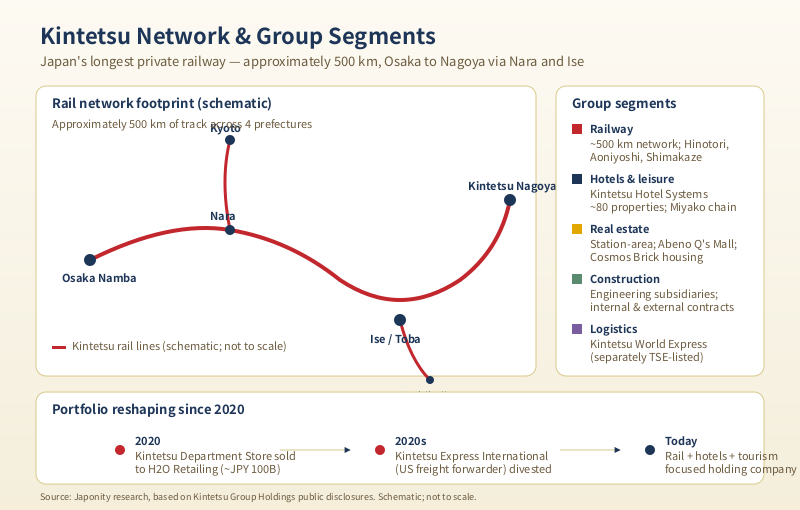
Kintetsu Group Holdings (TSE: 9041) operates Japan’s longest private railway network — approximately 500 kilometres of track linking Osaka, Nara, the sacred Ise-Shima coast, and Nagoya — a geographic footprint that no other private rail operator in Japan can match. Headquartered in Osaka’s Tennoji district, the group has spent the past five years pruning its portfolio: the 2020 sale of Kintetsu Department Store to H2O Retailing and the divestment of Kintetsu Express International, its US freight-forwarding arm, were among the largest restructurings undertaken by any Japanese private railway in a generation. What remains is a leaner conglomerate built around three reinforcing pillars: rail, hotels through the Miyako chain of approximately 80 properties, and inbound tourism anchored by Ise Jingu pilgrimage routes and Universal Studios Japan in Osaka. For investors and inbound partners assessing Japan’s regional infrastructure plays, Kintetsu is the indispensable Kansai-to-Chubu rail spine — and a very different beast from Tokyu, Hankyu Hanshin, or Seibu.
From Osaka Tramway to Kinki Nippon Railway: a wartime consolidation
Kintetsu’s corporate lineage begins in 1910 with the founding of Osaka Electric Tramway (Osaka Denki Kido), a modest interurban line connecting Osaka and Nara. Over the following three decades the company absorbed a succession of regional operators — Sangu Express Electric Railway, Kansai Express Railway, and Nara Electric Railway among them — through a mixture of organic extension and acquisitive consolidation. The decisive moment came in 1944, when wartime industrial policy forced the merger of Kansai Kyuko Tetsudo with Nankai Tetsudo to form Kinki Nippon Railway, the company that became universally known by its contraction, Kintetsu. After the war the Nankai lines were demerged, but the rest of the network — Osaka, Nara, Kyoto, Mie, and Aichi prefectures — remained under a single roof.
The result, eight decades later, is a private railway of unusual geographic scope. Where Tokyu’s network is largely confined to south-west Tokyo and Hankyu Hanshin’s to the Osaka-Kobe-Kyoto triangle, Kintetsu’s roughly 500-kilometre system crosses four prefectural boundaries and connects two of Japan’s three largest metropolitan economies. The flagship Hinotori limited express, introduced in 2020, runs the Osaka Namba-to-Kintetsu Nagoya route in just over two hours, offering a private-rail alternative to JR Central’s Tokaido Shinkansen for travellers willing to trade speed for comfort and price.
The portfolio reshaped: divestments since 2020
The COVID-19 era forced almost every Japanese rail operator to reconsider its conglomerate sprawl, but few moved as decisively as Kintetsu. In 2020 the group agreed to sell its Kintetsu Department Store subsidiary, including the landmark Abeno Harukas store at the foot of Japan’s tallest building, to H2O Retailing — parent of the Hankyu and Hanshin department-store chains — in a transaction valued at approximately JPY 100 billion. The deal consolidated Kansai department-store retail under H2O while freeing Kintetsu to redirect capital toward its rail-and-hotel core.
The same year, Kintetsu agreed to divest Kintetsu Express International, the US-based freight-forwarding subsidiary it had built out alongside its Tokyo-listed sibling Kintetsu World Express (KWE). The logic was straightforward: cross-border air and ocean freight forwarding is a scale business with thin margins and limited synergy to passenger rail. By concentrating logistics under KWE while exiting peripheral overseas operations, Kintetsu cleared the path to a more focused holding-company structure. Kintetsu Group Holdings was itself established in 2015 as the listed parent, with Kinki Nippon Railway operating as the wholly-owned railway subsidiary beneath it.
Segment composition: what Kintetsu Group does today
The post-divestment group reports across five principal segments. Railway operations remain the volume anchor, with daily ridership concentrated on the Osaka, Nara, Kyoto, Nagoya, and Yamada lines. Hotel and leisure, organised under Kintetsu Hotel Systems, operates the Miyako Hotel chain together with the Sheraton Miyako Tokyo and selected international properties — approximately 80 hotels in total under various brands. Real estate development, urban transit-oriented projects, and a long-distance bus and shipping segment round out the operating portfolio.
| Segment | Principal assets | Strategic role |
|---|---|---|
| Railway | Approximately 500 km network; Hinotori, Aoniyoshi, Shimakaze limited expresses | Daily ridership anchor; tourism gateway |
| Hotels & leisure | Kintetsu Hotel Systems; Miyako chain ~80 properties; Shima Spain Village | Inbound capture; weekend leisure ridership driver |
| Real estate | Station-area redevelopment; Abeno Q’s Mall complex; Cosmos Brick housing | Land-value capture along rail corridors |
| Construction & engineering | Kintetsu Real Estate, Cosmos Brick housing, engineering subsidiaries | Internal infrastructure plus external contracts |
| Logistics | Kintetsu World Express (KWE) — separately listed freight forwarder | Standalone scale business; reduced parent exposure post-divestment |
The Miyako brand and Kintetsu’s hospitality footprint
Kintetsu Hotel Systems is the operating arm for hospitality, and the Miyako brand is its most recognisable badge. The chain spans from urban flagships — the Hotel New Miyako in Kyoto, the Miyako Hotel Osaka — to resort properties on the Shima peninsula adjacent to Ise Jingu, and selected overseas locations. The total operating portfolio of approximately 80 hotels gives Kintetsu one of the larger domestic hotel footprints among Japanese rail operators, though it remains smaller than the JR-group hotel chains in absolute room count.
The strategic logic mirrors the model perfected by Hankyu and Tokyu: capture both the journey and the destination. A traveller riding the Shimakaze limited express to Kashikojima for an Ise Shrine pilgrimage is statistically likely to spend a night at a Shima Kanko Hotel or a Miyako resort; an inbound visitor connecting Osaka to Nara and Kyoto is a candidate for the urban Miyako properties. Kintetsu’s geographic concentration — the same prefectures it serves by rail — makes the hotels-as-pull-factor model unusually clean compared with peers whose hotel and rail footprints diverge.
Tourism strategy: Ise Shrine, USJ, and the inbound funnel
Tourism positioning is where Kintetsu most clearly diverges from Tokyu, Hankyu Hanshin, and Seibu. Two assets dominate. The first is Ise Jingu, the Shinto shrine complex in Mie Prefecture widely considered the spiritual heart of Japan. Kintetsu’s Yamada and Toba lines are the principal rail access from Osaka, Nagoya, and Kyoto; the company markets dedicated sightseeing trains — the Shimakaze and Aoniyoshi — explicitly to the pilgrimage and leisure traveller. The shrine attracts millions of visitors annually, and the rail journey itself is positioned as part of the experience rather than mere transit.
The second tourism anchor is Universal Studios Japan in western Osaka. While USJ itself sits on the JR Yumesaki Line, Kintetsu’s Namba and Osaka network feeds the broader inbound circulation around the park, and the group’s hotels and tour packages are heavily oriented toward USJ-bound traffic. Together, Ise Shrine and USJ give Kintetsu access to two of the most durable inbound demand pools in Japan — religious-cultural tourism on one side and entertainment tourism on the other.
The Kintetsu Buffaloes legacy and the corporate identity question
For a generation of Japanese baseball fans, “Kintetsu” was synonymous with the Buffaloes, the Nippon Professional Baseball franchise that the group owned from 1949 until 2004. The team produced several pennant winners and a string of marquee players, but persistent losses and the broader contraction of corporate-sponsored sports in Japan led to the 2004 merger with Orix BlueWave to form the present-day Orix Buffaloes. The exit closed a long chapter in Japanese baseball history and removed one of Kintetsu’s most public branding platforms.
The Buffaloes divestment, the 2020 department-store sale, and the freight-forwarding exit together describe a company that has spent twenty years narrowing rather than diversifying. The contrast with the conglomerate-expansion strategies pursued by some peers in the same period is sharp. The bet is that a focused rail-hotel-tourism group will trade at a higher multiple, and operate more efficiently, than a sprawling holding company with thin claims on consumer attention.

How Kintetsu compares: the private-rail conglomerate landscape
Japan’s private-railway sector is a distinctive corporate form. Each major operator combines rail with hotels, real estate, and retail, but the strategic emphasis and geography vary widely. Tokyu Corporation, centred on the Shibuya-to-Yokohama corridor, has invested heavily in Shibuya redevelopment and now derives a substantial portion of group profit from real estate rather than rail. Hankyu Hanshin Holdings combines two historic Kansai operators with significant entertainment exposure through Hankyu Department Store, Takarazuka Revue, and the Hanshin Tigers baseball franchise. Seibu Holdings retains a heavy resort and hotel orientation in the Tokyo region. Kintetsu’s distinguishing features are its geographic scope — the Osaka-Nara-Ise-Nagoya axis — and its concentration on tourism inflows tied to specific destinations rather than to metropolitan commuting alone.
The comparison with JR West is more nuanced. JR West, formerly a part of Japanese National Railways and privatised in 1987, operates the high-speed Sanyo Shinkansen and the bulk of Kansai conventional commuter rail. Kintetsu and JR West compete on selected corridors — most visibly Osaka-Nagoya, where the Hinotori limited express positions against the Tokaido Shinkansen — but the two are more complementary than directly substitutable. JR West runs the trunk lines; Kintetsu runs the destination feeders.
Working with Kintetsu Group
For overseas operators of consumer brands, tourism services, or transport technology, Kintetsu represents access to a uniquely concentrated geography — Kansai plus the western Chubu coast — and to two of Japan’s most durable inbound demand pools. Procurement, station-area retail, hotel supply, sightseeing-train collaborations, and inbound travel partnerships are all live commercial channels. Kintetsu Group Holdings reports to investors as TSE-listed entity 9041; the operating subsidiary Kinki Nippon Railway is wholly owned by the holding company. Inbound business-development enquiries can be initiated through Japonity’s business matching introduction service.
FAQ
How long is the Kintetsu rail network and where does it run?
Kintetsu’s railway network covers approximately 500 kilometres, the longest of any private railway operator in Japan. The system spans Osaka, Nara, Kyoto, Mie, and Aichi prefectures, with key endpoints at Osaka Namba, Kyoto, Kintetsu Nagoya, and Kashikojima on the Shima peninsula adjacent to Ise Shrine.
What did Kintetsu sell to H2O Retailing in 2020?
Kintetsu agreed in 2020 to transfer its Kintetsu Department Store subsidiary, including the Abeno Harukas flagship in Osaka, to H2O Retailing in a transaction valued at approximately JPY 100 billion. The sale consolidated Kansai department-store retail under H2O and allowed Kintetsu to refocus on rail, hotels, and tourism.
What is Kintetsu Hotel Systems and how large is it?
Kintetsu Hotel Systems is the group’s hotel operating company, running approximately 80 properties under various brands including the Miyako Hotel chain. The portfolio spans urban flagships in Osaka, Kyoto, and Tokyo, resort properties on the Ise-Shima coast, and selected international locations.
What happened to the Kintetsu Buffaloes baseball team?
The Kintetsu Buffaloes were a Nippon Professional Baseball franchise owned by Kintetsu from 1949 to 2004. In 2004 the team was merged with Orix BlueWave to form the present-day Orix Buffaloes, ending Kintetsu’s 55-year ownership of the franchise.
How does Kintetsu differ from Tokyu and Hankyu Hanshin?
The principal differences are geographic scope and tourism emphasis. Tokyu is concentrated in south-west Tokyo with heavy real-estate orientation; Hankyu Hanshin is the Osaka-Kobe-Kyoto triangle with entertainment and department-store exposure. Kintetsu uniquely spans Osaka-Nara-Ise-Nagoya — four prefectures — with tourism strategy anchored on Ise Shrine pilgrimage and Universal Studios Japan inbound flows rather than on metropolitan commuting alone.
Related from Japonity — Japan’s passenger railways & rail conglomerates
- JR East — The world’s largest railway by passengers — and Japan’s biggest station-retail empire
- JR Central — The Tokaido Shinkansen monopoly and the maglev moonshot
- Tokyu Corporation — The Shibuya-redeveloping rail conglomerate
- Hankyu Hanshin Holdings — Kansai’s railway-real-estate-entertainment empire
- Seibu Holdings — Tokyo’s western-suburb rail empire + Prince Hotels + Lions
Want to source Japanese products beyond these company profiles? Japonity also runs a Japan Sourcing Hub — a research-grade catalogue of 1,185 verified Japanese food products and 200+ overseas EC stores, ready for B2B procurement.
Interested in Japanese business opportunities?
Whether you're looking for technology partners, engineering talent, or market insights — we can help connect you with the right Japanese organizations.
Get in Touch →