It is dusk in Sotokanda, and the LEDs above Chuo-dori begin their nightly inventory: a hundred storefronts blinking awake, a rolling shutter clattering up here, an idol song looping out of a speaker there. Tour groups gather on the pavement, phones raised, mistaking the noise for the story. But the more interesting Akihabara is the one foreign retailers actually fly in for — a 1-km square that doubles as Japan’s most concentrated test market for anime, idol, and hobby IP. Every figure, every variant cover, every collab café here is part of a measurement system that license-holders in Tokyo, Osaka, and increasingly Shanghai watch closely. The neon is the surface; the spreadsheet underneath is the reason buyers keep coming back.
From radio tubes to Rem figures: a brief commercial history
Akihabara was not born otaku. In the years after 1945, the streets around what is now JR Akihabara Station became an informal market for surplus radio parts, vacuum tubes, and military electronics — the only place in Tokyo where a hobbyist could assemble a working receiver on a postwar budget. By the 1950s the area had been formalised as Akihabara Denki-gai, the Electric Town, and through the high-growth decades it served as Japan’s de facto consumer-electronics showroom: refrigerators, then televisions, then VCRs, then PCs.
The pivot to anime and manga retail began quietly in the late 1990s. As consumer electronics commoditised and big-box rivals in the suburbs ate the household-appliance business, Akihabara’s small-floorplate buildings — narrow, deep, vertically stacked — turned out to be perfectly suited to specialty hobby retail. Used-manga dealers, garage-kit makers, doujin (self-published manga) shops, and figure importers filled the space the appliance stores left behind. By the mid-2000s the neighborhood had been rebranded, formally and informally, as the world capital of otaku consumption. Yodobashi-Akiba, the camera-and-electronics chain’s flagship megastore, opened in 2005 on the east side of the station, less as a rebuke to that shift than as a hedge against it: an everything-store designed to capture both the salaryman buying a rice cooker and the collector buying a Gundam kit.
The anchor retailers: five vertical towers, five very different P&Ls
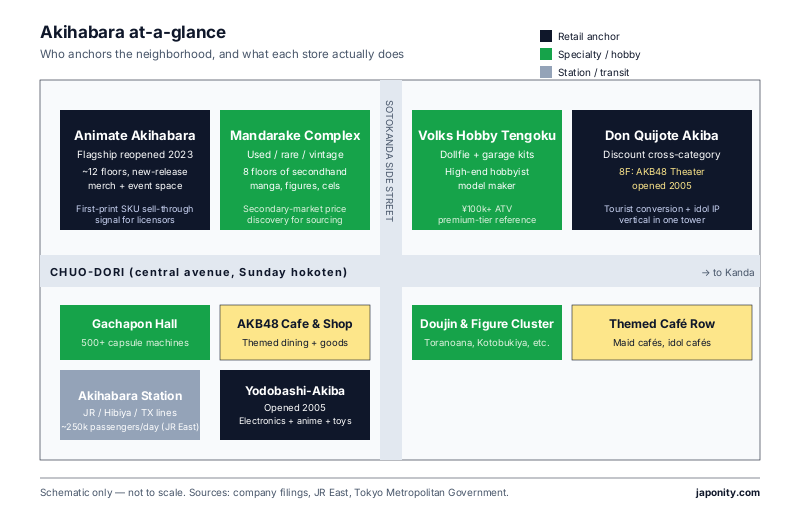
For a foreign buyer trying to read Akihabara, the first task is to stop treating it as one shopping district and start treating it as a cluster of five anchor businesses, each with a distinct economic role.
Animate Akihabara reopened in a much larger new flagship in 2023, on the western side of Chuo-dori. Animate is Japan’s dominant new-release anime and manga specialty chain, and the Akihabara branch operates as the flagship of the flagship: the place where licensors stage launch events, where first-print bonus items debut, and where sell-through in the first 72 hours is taken as a directional signal for the rest of the country. If a variant cover or an acrylic stand sells out at Animate Akihabara on day one, distributors elsewhere will move faster on the second order.
Mandarake runs the secondhand market in parallel — eight floors of used manga, vintage figures, animation cels, doujinshi, and out-of-print collectables. Mandarake is where the price discovery happens. A figure that retails for ¥12,000 new but trades at ¥35,000 used at Mandarake within six months is, in effect, a market vote on which IPs are deepening their collector base and which are softening. Sourcing scouts use Mandarake’s pricing the way a public-equity analyst uses the secondary market.
Volks Hobby Tengoku represents the premium end. Best known for its Dollfie ball-jointed dolls and high-end garage kits, Volks targets a customer whose average transaction value is measured in tens of thousands of yen rather than hundreds. For a foreign luxury or lifestyle brand exploring co-branded merch, Volks is the reference customer: passionate, disposable-income-rich, willing to wait months for a made-to-order edition.
Yodobashi-Akiba, just east of the station, plays a different role again. It is the largest single-building electronics store in Japan and one of the largest in Asia, but its upper floors carry a serious anime, model, and toy section that operates as the “mainstream-friendly” entry point — the place a tourist couple uncertain about visiting Mandarake will buy a Studio Ghibli plush instead.
Don Quijote Akihabara, the local branch of the national discount chain, anchors the southern stretch of Chuo-dori. Its 8th floor has, since 2005, housed the AKB48 Theater — the small-capacity venue where the AKB48 idol franchise built its daily-performance model and which remains the symbolic heart of that IP. Don Quijote itself sells everything from cosmetics to suitcases to liquor; the AKB48 theater on top makes the whole tower a kind of vertical case study in cross-merchandising tourist traffic against entertainment IP.
Beyond the anchors: gachapon halls, doujin shops, idol theaters, themed cafés
Surrounding the five anchors is a denser layer of specialty businesses, and each plays a distinct role in the IP economy.
Gachapon halls — capsule-toy arcades with five hundred or more machines under a single roof — function as low-cost product testing. A licensor can produce a limited gachapon run of a new character variant for a few million yen, watch how quickly the capsules clear in Akihabara over two weekends, and use that signal to decide whether to commit to a full figure SKU.
Doujin shops like Toranoana stock self-published manga and fan works, often illegally on the edges of copyright. They are also, in practice, a talent pipeline: many of Japan’s most commercially successful illustrators and writers were spotted in the doujin scene before being signed by major publishers.
Figure shops — Kotobukiya, Volks’s storefront, dozens of smaller dealers — are where the resin-and-PVC end of the business lives. Themed cafés, from the maid cafés that became Akihabara’s tourist shorthand to the more recent VTuber and idol collab cafés, monetise the IP differently: per-customer ticket, photo session, exclusive coaster. Idol theaters, with the AKB48 Theater as the canonical example, run the daily-performance economics that turned local idol groups into a national export. Each of these is a small business by revenue, but collectively they form the texture of the neighborhood — and the texture is what licensors are reading.
Who does what: a buyer’s-eye map of the neighborhood
| Retailer | Role in the IP economy | What it is good for, for a foreign buyer |
|---|---|---|
| Animate Akihabara | New-release flagship; launch signal | Reading which series have momentum this season; spotting first-print bonus formats |
| Mandarake Complex | Secondhand price discovery | Identifying which IPs have collector depth — and which are softening |
| Volks Hobby Tengoku | Premium hobbyist tier | Benchmarking the high-ATV customer for co-branded or luxury collabs |
| Yodobashi-Akiba | Mainstream entry point | Seeing which IPs have crossed over from otaku to general consumer |
| Don Quijote Akiba (AKB48 Theater) | Discount + idol IP vertical | Studying tourist conversion and idol-IP merchandising in one building |
| Gachapon halls | Low-cost product testing | Cheap, fast read on character variant demand |
| Doujin shops | Talent pipeline + IP edge cases | Spotting illustrators and writers before they sign with majors |
| Themed cafés | Experiential IP monetisation | Templates for collab cafés in your home market |
Why brands test-launch here
Three factors make Akihabara unusually well-suited as a test market, and they are worth naming explicitly because they explain why a brand or licensor pays the rent for visibility here even when cheaper retail space exists elsewhere in Tokyo.
The first is foot-traffic concentration. Akihabara Station handles roughly a quarter of a million passengers a day on JR lines alone, according to JR East passenger data, plus more on the Hibiya and Tsukuba Express lines. A weekend pedestrian count on Chuo-dori, when the avenue closes to cars as a hokoten (pedestrian paradise), runs into the tens of thousands of hours of dwell time per day. For a launch that needs eyes, few addresses in Asia match this.
The second is demographic concentration. The Akihabara visitor is not a representative Tokyoite — that is precisely the point. They are disproportionately core-fan: higher purchase intent, higher per-visit spend on hobby goods, higher tolerance for limited editions and queueing. For categories where the early adopter signals the wider market, this is the cleanest possible test environment.
The third is social-media velocity. Akihabara is one of the most photographed retail districts in Japan. A new storefront, a window display, or a queue forms social-media inventory within hours. License-holders measure this. A launch event that produces 5,000 X (Twitter) posts on opening weekend is, in 2026, a more useful signal than first-day sell-through alone.
Recent shifts: gentrification, tourist saturation, the Chinese return
Akihabara in 2026 is not the Akihabara of 2015. Several shifts matter for any foreign buyer planning a visit.
First, gentrification — the western edge of the neighborhood, toward Kanda and Ochanomizu, has seen new office towers and hotel openings that have pushed up ground-floor rents. Some smaller specialty shops have consolidated upward into higher floors of older buildings, or relocated to Nakano Broadway, the secondary otaku hub a few stops west. A buyer scouting in 2026 should plan to walk vertically, not just along Chuo-dori.
Second, tourist saturation — inbound visitor numbers to Tokyo have recovered fully from the pandemic and, as widely reported by Nikkei and others, are running at record levels. Akihabara on a Saturday afternoon is denser than at any point in the 2010s. That is good for foot-traffic-based businesses, less good for the niche specialty shops whose core customer is now occasionally crowded out.
Third, the return of Chinese tourist spending has changed the merchandising mix. Several anchor retailers now stock significantly more high-margin, gift-friendly SKUs — premium figures, sealed-box collectables — calibrated to the spending patterns of returning mainland tourists. Foreign buyers reading the windows in Akihabara today are reading, in part, a window curated for Chinese collector demand.
A two-day plan for a foreign retailer, brand, or scout
If you have flown in for forty-eight hours and want to leave with usable intelligence rather than souvenirs, the following itinerary is the one most experienced sourcing scouts converge on.
- Day 1, 09:30 — Arrive Akihabara Station, Electric Town exit. Take fifteen minutes to walk the length of Chuo-dori north to south before any store is open. You are mapping the storefronts and reading the new-launch posters; this is your baseline.
- 10:00 — Yodobashi-Akiba. Start mainstream. Walk the upper-floor toy, model, and anime sections. Note which IPs have endcap placement: those are the IPs that have crossed over from otaku to general consumer.
- 13:00 — Animate Akihabara flagship. Spend at least two hours. Photograph the new-release wall, the first-print bonus formats, the event-space signage. Buy two items from the current week’s launches to keep as a sales-rank reference.
- 16:00 — Mandarake Complex. Read prices, not products. Compare retail prices you saw at Animate against Mandarake’s secondhand asks on the same SKUs. Anything trading at 2x retail within months is signal.
- 19:00 — Themed-café row, north of Chuo-dori. Pick one collab café currently running. Order something, observe the per-customer ticket and merchandising bundle. This is your experiential-IP template.
- Day 2, 10:00 — Volks Hobby Tengoku. Premium tier. Talk to staff if you have any Japanese; if not, observe the customer demographic and the made-to-order signage.
- 12:30 — Gachapon hall (multiple locations). Spend ¥3,000 across three machines on different IPs. You are not collecting; you are testing the licensors’ variant strategy.
- 14:00 — Doujin shop (Toranoana or equivalent). Walk the floors. You are scouting illustrator names — note any artist appearing in three or more anthologies.
- 16:00 — Don Quijote Akiba, all eight floors. Bottom to top. End on the 8th: the AKB48 Theater, even from outside, is the case study in vertical IP-and-retail integration.
- 18:00 — Return walk along Chuo-dori, debrief. Sit in a coffee shop and write your notes before you leave the neighborhood. The signals decay quickly once you are back at the hotel.
The wider point
Foreign visitors to Tokyo tend to treat Akihabara as either spectacle (the neon, the maid cafés, the tour-bus stop) or as nostalgia (a place that has been written about so many times its story feels finished). Neither framing is correct in 2026. The neighborhood is, more than ever, a working node in the global anime and hobby economy — the place where launches are stress-tested, where secondhand pricing sets reference values, where licensors read the windows the way analysts read the tape. For a foreign retailer or brand executive, two days in Akihabara, walked with the right questions, will produce more usable intelligence than two weeks of pitch decks from Tokyo agencies. The neon is still there. The spreadsheet underneath is what you came for.
FAQ
Is Akihabara still the best place in Tokyo to source anime merchandise?
For breadth and signal value, yes — particularly for new-release reads at Animate, secondary-market pricing at Mandarake, and premium-tier benchmarking at Volks. Nakano Broadway is a worthwhile secondary stop for deeper used and vintage stock, but Akihabara remains the primary test market that license-holders themselves watch.
Can foreign retailers buy directly in Akihabara, or is this only a scouting trip?
Most anchor stores will sell to anyone at retail, including in volume, but wholesale relationships go through Japanese distributors, not the storefronts. The realistic use of an Akihabara visit is intelligence-gathering and supplier identification; the wholesale contract is signed elsewhere, often through a trading-house intermediary.
What is the right length of stay for a buyer’s visit?
Two full days, ideally one weekday and one weekend day. The weekday gives you cleaner store observation; the weekend, particularly the Sunday pedestrian-paradise on Chuo-dori, gives you the foot-traffic and event-launch signal.
How has the post-pandemic tourist recovery changed Akihabara?
Inbound visitor numbers are at record levels, and merchandising mix has shifted toward higher-margin, gift-friendly SKUs aimed at returning Chinese collector demand. For a foreign buyer this means that the windows are partly curated for tourist purchase patterns — a useful signal in itself, but one to read carefully when extrapolating to your home market.
Is Akihabara safe to visit as a foreign business traveller?
Yes. The neighborhood is policed, well-lit, and densely staffed; the main caution is that the maid-café and themed-café scene includes some operators with aggressive street touts and inflated pricing. Stick to established storefronts and you will have no issues.
Looking to source anime, hobby, or idol merchandise from Japan, or to scout retail formats and IPs in Akihabara with on-the-ground support? Get in touch via Japonity’s business-matching service — we connect foreign buyers, brands, and scouts with the right Japanese partners.
More from Japonity’s Japan Anime Business series
This article is part of a 10-piece editorial cluster on the business of Japanese anime. Read the rest:
- Inside Japan’s Anime Production Committee — How the money and rights really flow inside the joint-venture structure that funds almost every Japanese TV anime.
- Japan’s Anime Export Boom — Why overseas anime sales topped ¥1.7 trillion and overtook domestic for the first time in 2023.
- The 10 Anime Studios Behind 80% of Output — A ranked, opinionated business map of the studios that dominate foreign-licensed Japanese animation.
- Licensing Anime IP: A 2026 Foreign Buyer’s Guide — Why Western licensing instincts produce wrong answers in Japan, and the eight-stage flow that actually closes deals.
- The New Geography of Anime Streaming — Crunchyroll, Bilibili, Netflix, Disney+ and others split the world by region, rights and business model.
- VTuber Economics — Inside the billion-dollar virtual influencer industry built by Cover (Hololive) and ANYCOLOR (Nijisanji).
- The Anime Merchandise Pipeline — From Tokyo factories to Comic-Con booths — how an anime figure actually travels to a foreign retail shelf.
- Japan’s Trillion-Yen Manga Industry — Inside a publishing business larger than anime — and the four Tokyo houses every foreign publisher should know.
- A Day in the Life of an Anime Animator — Inside the working day of a rank-and-file animator, and the structural reasons wages stay low across the industry.
Sourcing beyond anime? Japonity also runs a Japan Sourcing Hub — a research-grade catalogue of 1,185 verified Japanese food products and 200+ overseas EC stores that already stock them, with HS codes, certifications and supplier MOQs ready for B2B procurement.
Interested in Japanese business opportunities?
Whether you're looking for technology partners, engineering talent, or market insights — we can help connect you with the right Japanese organizations.
Get in Touch →