A single Demon Slayer 1/7-scale figure can move 30,000 units globally at $200-plus retail — and almost none of that money flows back to the studio that drew the character. The pipeline that turns a frame of animation into a $60 Nendoroid on a Comic-Con booth runs through a stack of licensors, hobby manufacturers, region-locked storefronts and Western master distributors that most foreign retailers map incorrectly the first time. Anime merchandise is one of the larger revenue buckets reported by the Association of Japanese Animations, with trade press estimates putting the global figure-and-collectibles category at several billion dollars a year. The opacity is structural — committee licensing, MG-and-royalty contracts, MOQs in tens of thousands of units — and it is why a sourcing manager from Texas can stand in Akihabara and still not understand how to land a container of legal product on a U.S. shelf. This is the map.
The licensors: who actually owns the merchandise rights
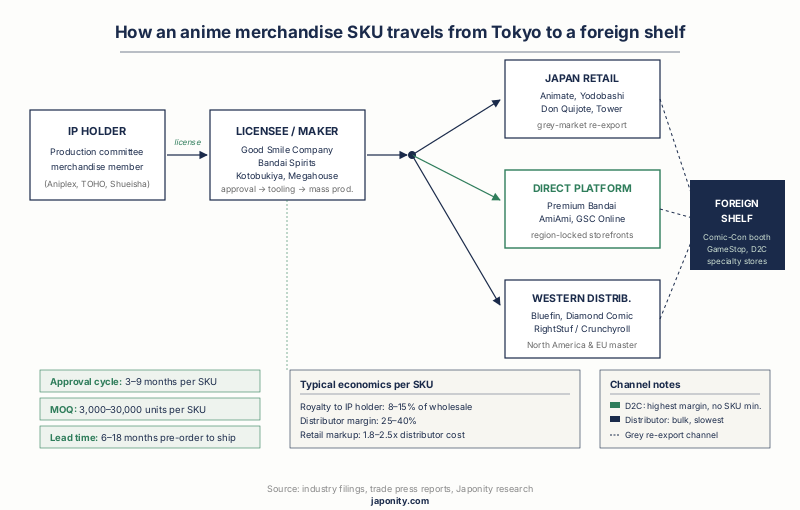
In Japanese anime, the studio that animates a series almost never owns merchandise rights to the characters on screen. Production is financed by a seisaku iinkai — a production committee — typically a consortium of a TV broadcaster, a manga publisher, a record label, a toy company and an anime distributor. Each member contributes capital and in exchange receives windowed rights: home video, music, overseas streaming, and merchandise. The merchandise member, often a toy or hobby company such as Aniplex, Bandai or Good Smile, sub-licenses to manufacturers who pay an advance (MG, or minimum guarantee) against a royalty stream.
This matters operationally because a foreign buyer who wants legal product cannot simply approach the studio — the studio has no rights to sell. The buyer must identify which committee member holds merchandise rights for that title, then find the manufacturer with the sub-license for the relevant category: figures, plush, apparel, food collabs, stationery and capsule toys are typically broken out separately. For megahits, rights may be parcelled across half a dozen manufacturers; for smaller titles, a single licensee may hold everything.
Two practical implications. First, the same character can be made by three or four manufacturers at once, at different scales, because rights are sliced by category, not by character. Second, royalty bands are roughly standardised — trade press reports point to 8 to 15 per cent of wholesale flowing back to the IP holder, before MG amortisation. Landed cost is not a negotiation between you and a factory; two royalty layers and an approval bureaucracy are baked in before you see the SKU.
The upstream manufacturers
The Japanese anime hobby industry is concentrated in a small group of specialist makers, each with a recognisable house style, price band and distribution posture. Foreign sourcing teams who treat them as interchangeable suppliers will misprice every category.
Good Smile Company — privately held, founded in 2001, headquartered in Tokyo — is the most visible figure manufacturer outside Japan. Its Nendoroid line (chibi-proportioned articulated figures, roughly 10 cm tall, $50 to $80 wholesale band) and its scale figure lines (1/7 and 1/8 PVC statues, $150 to $300 at retail) are the genre’s reference points. GSC also operates Max Factory and several joint ventures and has invested heavily in direct international logistics through its online storefront and partner network.
Bandai Spirits is the hobby and collectibles division of Bandai Namco, carved out in 2018, and is the single largest revenue centre in the category. It owns Gunpla (Gundam plastic model kits, a category Bandai effectively created and still dominates), the prize-figure machine that supplies Japan’s crane-game arcades, and the Premium Bandai online platform. Its product range stretches from $8 capsule prize figures to $400 Master Grade Gundam kits and $1,000-plus Chogokin die-cast collectibles.
Premium Bandai — note the distinction — is not a maker but a direct-to-consumer storefront operated by Bandai Spirits. It carries the “limited” and “online-exclusive” SKUs that never appear in Animate or Yodobashi. It runs region-segregated storefronts (Japan, North America, EU, Asia) and is, for many premium SKUs, the only legal channel.
Kotobukiya specialises in scale figures, Frame Arms Girls and Megami Device model kits, and Marvel and DC statues for the U.S. market — with a strong Western specialty-store footprint via Bluefin and Diamond Comic.
Megahouse, part of the Bandai Namco group, runs the Portrait of Pirates (One Piece) and G.E.M. lines. Square Enix manufactures its own Play Arts and Bring Arts collectibles around game IP. Aniplex+ is Sony Music’s hobby storefront for Aniplex-owned franchises (Demon Slayer, Fate, Sword Art Online). And the prize-figure specialists — Taito, Furyu, Sega Lucky — supply the crane-game economy with mid-tier figures that ultimately fuel the global grey market.
| Maker | Specialty | Retail price band | Foreign distribution model |
|---|---|---|---|
| Good Smile Company | Nendoroid, scale figures, plush | $50–$300 | D2C + Western distributors |
| Bandai Spirits | Gunpla, prize figures, Chogokin | $8–$1,000+ | Premium Bandai regional sites + Bluefin |
| Kotobukiya | Scale figures, model kits, Western IP statues | $80–$400 | Bluefin / Diamond Comic master |
| Megahouse | One Piece P.O.P., G.E.M. | $80–$350 | Bandai group distribution |
| Square Enix | Game-IP collectibles | $70–$250 | SQEX own stores + specialty |
| Aniplex+ | Premium figures, Sony-owned anime IP | $150–$400 | D2C, region-locked |
| Taito / Furyu / Sega | Prize figures (crane game) | $20–$40 | Grey market re-export |
The Japan retail channels
Inside Japan, merchandise flows through a small set of dominant channels. Animate, with more than 150 stores and a flagship in Ikebukuro, is the country’s largest anime specialty retailer; for smaller titles its demand signal effectively dictates how many SKUs a licensee will commit to. Yodobashi Camera and Bic Camera carry higher-volume hobby SKUs through their toy floors. Don Quijote moves price-aggressive prize-figure and capsule-toy volume to a tourist and value-seeker audience. Tower Records Japan remains relevant for music-anime crossover merchandise around anniversary tours and idol franchises. Specialty hobby shops — Volks, Surugaya, Mandarake — handle higher-end and second-hand inventory.
Layered on top is the online direct channel: Premium Bandai for Bandai Spirits exclusives, Good Smile Online Shop, and AmiAmi — the largest pure-play hobby e-tailer, a significant wholesaler in its own right, and one of the few public sources of clean retail price-discovery for non-exclusive SKUs.

The export route — distributors, conventions and D2C
Anime merchandise reaches a Western shelf through three structurally different routes, and each has its own economics.
The first is the master distributor model. In North America, Bluefin Distribution is the dominant master distributor for Bandai Spirits, Good Smile and several smaller makers, supplying GameStop, specialty stores and Amazon marketplace sellers. Diamond Comic Distributors handles pop-culture-adjacent collectibles into independent comic shops. Europe is more fragmented, with Bandai Namco Europe in-house and country-level distributors in France, Germany and the UK. Master distributors take inventory risk and typically operate on 25 to 40 per cent gross margins between landed cost and wholesale-out.
The second is direct-to-consumer. Premium Bandai operates dedicated North American, European and Asian storefronts; Aniplex+ runs its own regional D2C; Good Smile ships globally. The largest disruption has come from Crunchyroll, which following its acquisition by Sony has vertically integrated upwards from streaming into merchandise — the Crunchyroll Store now functions as a major Western retail channel for Aniplex-affiliated and partner-licensed product, materially shifting bargaining dynamics with traditional distributors. RightStuf, the long-running North American anime retailer, was acquired by Crunchyroll in 2022 and folded into the same channel.
The third is the convention channel. Anime Expo (Los Angeles), New York Comic Con, San Diego Comic-Con and Anime NYC together move a material share of premium SKUs — convention-exclusive variants, signing-event pieces and limited drops that bypass normal retail. Booth operators are a mix of licensee-direct (Good Smile USA, Bandai Namco, Aniplex of America) and licensed third-party retailers. For a foreign brand considering entry, this is one of the few places where SKU-level testing at limited volume is operationally feasible.
Amazon Japan and global Amazon marketplaces sit alongside all three routes, populated by a mix of authorised resellers and grey-market importers, and represent the largest single source of cross-border B2C volume in the category.
SKU economics: MOQs, lead times and the approval bureaucracy
The numbers governing a single SKU are tighter than most consumer-goods buyers expect. A typical scale-figure SKU runs at an MOQ of 3,000 to 10,000 units for the global production run; large hit-title SKUs reach 20,000 to 30,000. Prize figures and capsule toys run far higher — 50,000-plus — because the unit economics demand it. Plush, apparel and stationery sit in between, reflecting lower tooling cost.
Lead times consistently surprise new entrants. From pre-order announcement to shipment, six to eighteen months is the working assumption for figures. The bottleneck is rarely manufacturing; it is the IP-approval cycle. Every prototype passes through the licensor’s approval team for sculpt, paint, packaging and final production-sample approval — three to nine months of cumulative approval time is normal, and any rejection rolls the schedule by weeks. Pre-order economics dominate: a meaningful share of figure SKUs is sold out months before they land.
Financially, a foreign distributor takes 25 to 40 per cent gross between landed cost and wholesale-out, the retailer marks the wholesale price up 1.8 to 2.5 times, and the IP holder receives 8 to 15 per cent of wholesale — recouped against an MG that for a major title can run into seven figures. Price flexibility on legal product is structurally limited.
The gachapon, blind-box and prize-figure carve-out
One channel deserves separate attention because it confuses most foreign retailers: the prize-figure economy. Prize figures — from Banpresto (now Bandai Spirits), Taito, Furyu and the SEGA Prize line — are not sold at retail in Japan. They are placed into UFO catcher crane games and are, technically, prizes won by players. Volumes are enormous; quality is often surprisingly good; pricing, when these figures reach foreign markets via grey-channel re-export through AmiAmi or HobbyLink Japan, is dramatically lower than equivalent scale-figure SKUs.
The same logic applies to gachapon and blind-box collectibles, where a $5 capsule cannot support a normal retail SKU structure. The route to ship is grey — there is no clean licensor-blessed channel for most of these SKUs. For chain retailers with brand risk this is a channel to monitor, not to source from; for specialty importers and convention vendors it has been the bedrock of the category for two decades.
2026 outlook: China, vertical integration and digital experiments
Three forces are reshaping the pipeline.
The first is Chinese demand. Chinese collectors are now the largest single foreign buyer cohort for premium Japanese figures, and Chinese-headquartered manufacturers — Pop Mart most visibly — have built a credible blind-box and designer-toy business that increasingly competes for licensor attention. Japanese committees are responding by licensing more aggressively to Chinese partners, which is starting to shift where some SKUs are physically made even when the IP remains Japanese.
The second is Crunchyroll’s vertical integration. With Sony controlling both the largest Western anime streaming platform and, through Aniplex, one of the largest anime production committees, the historical separation between content, distribution and merchandise is collapsing on the Western side. Independent distributors have flagged margin compression as Crunchyroll Store and Aniplex+ pull premium SKUs into their own channels.
The third is digital. NFTs and digital collectibles experimented with by several Japanese licensors during 2021–2023 largely underperformed, but the broader idea of digital companion goods to physical SKUs — proof-of-authenticity, holder-only drops — is being quietly trialled. None of this displaces the physical pipeline, but licensee selection criteria for a new foreign retail partner now include digital sophistication alongside shelf reach and approval throughput.
For a sourcing manager landing in Tokyo in 2026, the operating answer has not changed. Identify the committee. Identify the merchandise rights holder. Identify the manufacturer with category-specific rights for the titles you want. Decide whether you want distributor volume or D2C margin. Plan for an eighteen-month forward pipeline. And budget for the fact that the approval bureaucracy, not the factory floor, determines whether your first container ships on time.
FAQ
Can a Western retailer license a Japanese anime IP directly for original merchandise?
In principle yes — but the licensor is the production committee or the merchandise-rights holder on the committee, not the studio, and the contract structure typically requires an MG (minimum guarantee) in the high five to seven figures for a major title, plus an 8–15 per cent royalty on wholesale and a full approval cycle for every SKU. Most retailers find it more practical to source through an existing licensee like Good Smile or Bandai Spirits than to license originally.
What is the difference between Bandai Spirits and Premium Bandai?
Bandai Spirits is the hobby and collectibles manufacturing division of Bandai Namco. Premium Bandai is its online direct-to-consumer storefront, where many limited and online-exclusive SKUs are sold and which operates region-specific sites (Japan, North America, EU, Asia). Buying from Premium Bandai’s Japanese site for resale in another region typically violates the storefront’s terms.
What MOQ should I expect for an anime figure SKU?
Scale figures typically run 3,000 to 30,000 units per SKU for the global production run, with smaller titles at the low end and major franchises at the high end. Prize and capsule SKUs run at much higher MOQs (50,000-plus). Plush, apparel and stationery typically sit in the 3,000 to 10,000 range depending on tooling cost.
Is it legal to import Japanese prize figures into the U.S. or EU?
Prize figures are technically distributed as game prizes in Japan, not as retail goods, and there is no clean licensor-blessed retail channel for most of them outside Japan. Re-export through grey-channel importers is widespread and has operated for two decades, but the licensing posture is ambiguous and chain retailers with brand-risk concerns generally avoid it. Specialty importers and convention vendors source heavily from this channel.
How long does it take to get a new anime merchandise SKU from concept to shelf?
Six to eighteen months is the working assumption for figures. The longest leg is rarely manufacturing — it is the IP-approval cycle, which can absorb three to nine months across sculpt, paint, packaging and production-sample reviews. Plan inventory and marketing pre-orders accordingly.
Working with Japanese anime merchandise suppliers
Japonity helps foreign retailers, importers and brand teams identify the right Japanese merchandise licensee for a given title, navigate the production-committee structure, and structure first-order economics that survive the approval cycle. Talk to us: japonity.com/business-matching.
More from Japonity’s Japan Anime Business series
This article is part of a 10-piece editorial cluster on the business of Japanese anime. Read the rest:
- Inside Japan’s Anime Production Committee — How the money and rights really flow inside the joint-venture structure that funds almost every Japanese TV anime.
- Japan’s Anime Export Boom — Why overseas anime sales topped ¥1.7 trillion and overtook domestic for the first time in 2023.
- The 10 Anime Studios Behind 80% of Output — A ranked, opinionated business map of the studios that dominate foreign-licensed Japanese animation.
- Licensing Anime IP: A 2026 Foreign Buyer’s Guide — Why Western licensing instincts produce wrong answers in Japan, and the eight-stage flow that actually closes deals.
- The New Geography of Anime Streaming — Crunchyroll, Bilibili, Netflix, Disney+ and others split the world by region, rights and business model.
- Why Akihabara Still Matters — Behind the neon, Tokyo’s Akihabara is a working B2B test market for anime IP — a foreign buyer’s walking tour.
- VTuber Economics — Inside the billion-dollar virtual influencer industry built by Cover (Hololive) and ANYCOLOR (Nijisanji).
- Japan’s Trillion-Yen Manga Industry — Inside a publishing business larger than anime — and the four Tokyo houses every foreign publisher should know.
- A Day in the Life of an Anime Animator — Inside the working day of a rank-and-file animator, and the structural reasons wages stay low across the industry.
Sourcing beyond anime? Japonity also runs a Japan Sourcing Hub — a research-grade catalogue of 1,185 verified Japanese food products and 200+ overseas EC stores that already stock them, with HS codes, certifications and supplier MOQs ready for B2B procurement.
Interested in Japanese business opportunities?
Whether you're looking for technology partners, engineering talent, or market insights — we can help connect you with the right Japanese organizations.
Get in Touch →