A European streamer signs a license with a Japanese animation studio for a hit series, then discovers six months later that the studio doesn’t actually own the streaming rights they thought they bought — those sit with a different committee member, and the deal has to be torn up and renegotiated from scratch. This is not a rare horror story; it is the single most common opening mistake foreign buyers make when entering Japanese anime IP. The structural reason is that anime rights in Japan are deliberately fragmented across a production committee, and Western licensing instincts — “find the studio, sign the deal” — produce wrong answers more often than right ones. Before you sign anything, you have to learn to read Japan’s rights structure. This guide walks through how.
The structural reality, in one paragraph
Most commercial anime in Japan is financed by a production committee (seisaku iinkai): a syndicate of typically 5–10 companies that each chip in budget and, in exchange, each receive a specific category of exploitation right. The animation studio that physically makes the show is often only one member of the committee, and frequently not the rights-holder for the right you want. We have written a deeper structural explainer (our deeper explainer here); for the rest of this article, take it as given that “the rights” are not held in one place.
What this means operationally: before you draft a term sheet, you need to know which committee member holds the specific right you want, in the specific territory you want, for the specific window you want. Skipping that diligence is what produces six-month resets.
Step 1: Identify the right you actually need
“Anime rights” is a category, not a thing. A licensing deal must specify exactly which exploitation right you’re acquiring. The major categories, and the committee member who typically holds each one, look roughly like this:
| Right category | Typical holder on the committee | What it covers |
|---|---|---|
| Broadcast (linear TV) | TV network member (e.g. TV Tokyo, MBS) | Linear over-the-air or cable broadcast in Japan; overseas broadcast often via separate window |
| Streaming / SVOD (overseas) | Distributor / licensor member (Aniplex, Toei International, TMS Entertainment, Sentai Filmworks, Crunchyroll’s licensing arm) | Foreign streaming, by territory and platform-type |
| Home video | Distributor member or dedicated home-video company | Physical and digital sell-through; often bundled with SVOD |
| Merchandise | Toy / merch member (Bandai Namco, Good Smile, Movic) or a licensing agency appointed by the committee | Figures, apparel, stationery, F&B, all SKU categories — sub-divided by category |
| Music / soundtrack | Music label member (Aniplex, Pony Canyon, Lantis) | OST releases, sync licensing, performance rights |
| Theatrical | Distributor or dedicated theatrical member (Toei, Toho) | Cinematic release windows, festival circuit |
| Publishing / manga | Publisher member (Kodansha, Shueisha, Shogakukan) | Source manga or novel; almost always pre-existed the anime |
| Games | Game company member (Bandai Namco, Square Enix) or carved out | Console, mobile, gacha, arcade |
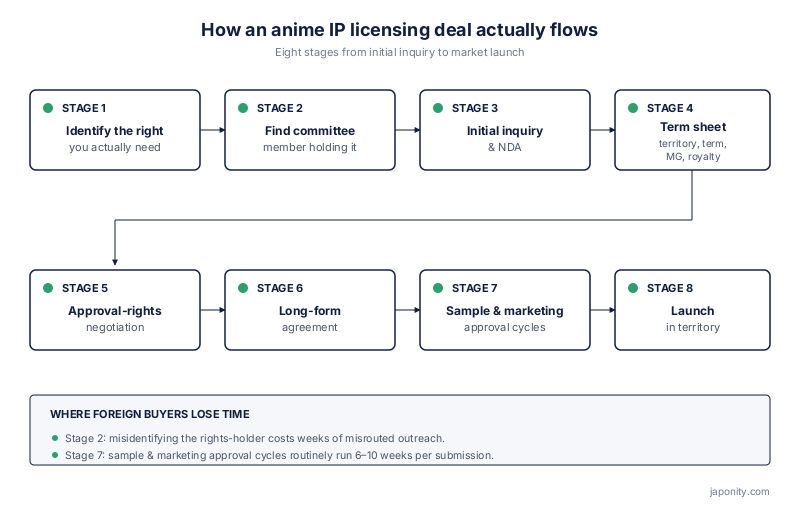
The first practitioner discipline is precision. “We want the streaming rights” is not enough. You want, for example: non-exclusive SVOD streaming rights in the United Kingdom and Ireland, in English-language with subtitles only (no dub rights), for a five-year term starting on the first broadcast date in Japan, with a six-month exclusive window against any other SVOD platform in that territory. Every clause in that sentence will be negotiated, but at least you’ve now described an actual thing.
Step 2: Identify the right counterparty
Once you know which right you need, you have to find which committee member holds it. The committee composition is usually disclosed in the show’s end credits and on official sites, but the right-by-right allocation is not public. There are three reliable ways to find out:
- The overseas distributor member. For streaming and home video outside Japan, the path usually runs through one of the major overseas licensors — Aniplex of America, Toei International, TMS Entertainment, Sentai Filmworks, or Crunchyroll’s licensing arm. They will tell you quickly whether they hold the right you want; if they don’t, they often know who does.
- The Japanese ad agency / trading house attached to the committee. Dentsu, Hakuhodo, ADK, Sumitomo Corporation, Sojitz and similar are frequently committee members specifically because they coordinate cross-rights deals. They are typically the most informed single point of contact.
- A specialised IP consultancy or business-matching service (the Japonity model). For foreign companies without an existing relationship into the committee, a Japan-side intermediary will identify the right holder and the right contact within them — often in a single week of work — versus the multiple months that cold outreach typically consumes.
Step 3: Understand typical terms
Japanese anime licensing has its own market norms. They are not radically different from US/EU practice, but they are different enough that walking in with a Western template will get you re-papered. The norms that matter most:
Territory definition
Territory is almost always carved by country and by language, sometimes both simultaneously. “Worldwide ex-Asia” is a real category but is increasingly broken up. Expect committees to push for narrower territory; expect to define dubbed-language territory separately from subtitled-language territory.
Term length
Five to seven years is the industry norm for streaming and home-video rights, with renewal options. Merchandise deals are often shorter (two to three years) because committees want to retest the market. Theatrical and broadcast windows are typically defined in months, not years.
Minimum guarantees and royalty bands
Streaming and home-video deals are typically structured as a minimum guarantee (MG) recoupable against royalties. For mid-tier titles, MGs are typically in the low-six-figure USD range per territory; for top-tier shōnen-class titles they run into the seven figures. Royalty rates are typically low-single-digit royalty percentages on net wholesale for merchandise and a percentage of subscriber-attributable revenue (or a per-stream rate) for SVOD. Trade press is the best public benchmark; private deal terms vary widely.
Sub-license rights
By default, you do not have the right to sub-license. If you are an aggregator who plans to distribute to other platforms in your territory, the right to sub-license must be explicitly granted and is typically subject to committee approval on each sub-licensee. Western buyers routinely assume they can re-sell rights inside the territory and discover at signing that they cannot.
Approval rights
The committee will retain extensive approval rights over how its IP is used: dubbed-voice casting, dub-script translation, marketing creative, packaging, merchandise samples, retail partners, even in-store placement in some cases. These approvals are not symbolic; they are exercised in detail.
Payment cadence
MG is typically paid in two or three tranches (signing, delivery of materials, first launch). Royalty statements are usually quarterly, with payment 60–90 days after period close. Japanese accounting practice and consumption-tax handling will appear in the contract; have a Japan-tax-literate counsel review.

Step 4: The approval process — where months disappear
This is the single area where Western buyers most consistently underestimate the timeline. Approval cycles in Japanese anime licensing are real, sequential, and unhurried.
For merchandise, every SKU is typically submitted in three rounds: initial concept (sketches), pre-production (sample with full art), and pre-shipment (final production sample). Each round can take 6–10 weeks of committee response time. A merchandise programme of 30 SKUs across apparel and figures, fully approved, regularly takes nine to twelve months from term-sheet signing to shelf — not because anyone is being obstructive, but because the committee is genuinely reviewing.
For streaming, sample approval is lighter (you’re not creating new art) but dub-language work attracts its own approval cycle: cast list, recorded sample lines, full episode samples, marketing creative. Plan for 8–12 weeks of approval activity on a six-episode dubbed launch.
For marketing, every key-art adaptation, social post template, trailer cut, and out-of-home creative is approval-bound. Build a marketing-approval pipeline into your launch plan from week one; do not treat it as a final step.
The practitioner takeaway: if your business model requires you to be in-market within four months of signing, you have probably already designed a project that will fail. Either widen your timeline or carve a tighter, fully-pre-approved package.
Step 5: Sign through a Japan-side intermediary
Foreign buyers face a strategic choice: go direct to the committee member, or run the deal through a Japan-side intermediary.
Direct has advantages: lower fees, direct relationship, faster information flow on commercial terms. The cost is that you carry the cultural, linguistic and procedural overhead yourself. Direct works well for buyers with an existing Tokyo office, a Japanese-speaking deal lead, and prior anime-licensing experience.
Indirect — through a Japanese trading house, advertising agency, or specialised IP consultancy — costs more (intermediary fees are typically a percentage of MG and/or an ongoing percentage of royalty, or a flat success fee). What you buy is: the right initial counterparty, faster turn on approvals, escalation paths inside the committee when things stall, and a culturally fluent translator of intent. For a first-time foreign buyer of mid-tier IP, this is almost always the right call. The mistake is not “using an intermediary”; the mistake is using the wrong one — a generalist consultancy with no anime track record will slow you down rather than speed you up.
The five most common mistakes foreign buyers make
- Signing with the animation studio when the studio does not hold the right. The studio is one member of the committee; it may hold no commercial rights at all. Verify who holds your right before you start drafting.
- Confusing market exclusivity with platform exclusivity. “Exclusive in the UK” can mean exclusive against all SVOD platforms, exclusive against direct competitors only, or exclusive against new entrants for a window. The committee will read it narrowly; you must define it precisely.
- Underestimating the dub-rights split. Subtitled rights and dubbed rights for the same territory are routinely held differently and licensed separately, with different MGs and approval flows. Assuming one deal covers both is a frequent re-papering event.
- Treating SKU approvals as a formality. Western retailers expect to lock a Q4 holiday assortment by spring. The committee’s approval pipeline does not bend to that calendar. Plan accordingly or pre-approve a tight SKU set.
- Skipping the Japan-side intermediary on a first deal. Foreign buyers routinely save the intermediary fee on the first deal and then spend three times as much in legal and lost time. Use one; pick one with anime-specific track record.
When NOT to license — and commission original anime instead
Licensing existing IP is the right move when you want a known title with established fan demand in your territory and your business model is distribution or merchandise. It is the wrong move when you actually want a brand-aligned story under your control — for that, commissioning an original or co-producing into a committee as an equity member is the better structural play. Co-production gets you a board seat on the rights allocation rather than a downstream licence; the trade-off is upfront capital (mid-eight-figure JPY ranges and up, depending on scope) and a multi-year horizon. Streamers entering Japanese anime as a strategic content category increasingly choose this path rather than the licence-by-licence approach.
FAQ
How long does a typical anime licensing deal take to close?
From first inquiry to signed long-form agreement, expect three to six months for a standard mid-tier streaming or merchandise deal. Add another two to four months before you are actually in-market, due to approval and dubbing cycles. Complex multi-rights or multi-territory deals routinely run nine to twelve months.
Can I license anime directly from the studio, or do I always need to go through a committee?
You can only license directly from the studio for the rights the studio actually holds, which in most committee-financed productions is limited. For older or studio-funded productions (less common but they exist), direct studio licensing is possible. The first diligence step is always to verify the rights structure of the specific title.
What does a typical minimum guarantee look like for a mid-tier streaming licence?
Per trade-press benchmarks, mid-tier titles in mid-sized Western territories typically attract minimum guarantees in the low-six-figure USD range. Top-tier shōnen-class titles run an order of magnitude higher. These are recoupable against royalties, not in addition to them.
Do I need a Japanese lawyer for an anime licensing deal?
You need counsel familiar with Japanese contract law and consumption-tax treatment, even if the governing law of your agreement is English or US. Standard Western IP counsel without Japan expertise will miss issues that matter at performance and at tax filing. Most foreign buyers use a US/UK lead firm plus Japanese co-counsel.
How do I get introduced to the right committee member if I have no Tokyo network?
The two practical paths are: the title’s known overseas distributor (Aniplex of America, Toei International, TMS, Sentai, Crunchyroll’s licensing arm), or a Japan-side business-matching service that maintains direct relationships into the major committees and trading houses.
Where Japonity fits
For foreign buyers entering anime IP licensing for the first time, the difference between a clean nine-month launch and an eighteen-month re-papering exercise usually comes down to the first two weeks of counterparty selection. Japonity’s Business Matching service introduces foreign streamers, retailers, distributors and brand owners directly to the right committee member or trading-house counterpart for the specific right they want to acquire — verified, briefed, and ready to negotiate. If you are evaluating Japanese anime IP, start there. Talk to Japonity’s Business Matching team.
More from Japonity’s Japan Anime Business series
This article is part of a 10-piece editorial cluster on the business of Japanese anime. Read the rest:
- Inside Japan’s Anime Production Committee — How the money and rights really flow inside the joint-venture structure that funds almost every Japanese TV anime.
- Japan’s Anime Export Boom — Why overseas anime sales topped ¥1.7 trillion and overtook domestic for the first time in 2023.
- The 10 Anime Studios Behind 80% of Output — A ranked, opinionated business map of the studios that dominate foreign-licensed Japanese animation.
- The New Geography of Anime Streaming — Crunchyroll, Bilibili, Netflix, Disney+ and others split the world by region, rights and business model.
- Why Akihabara Still Matters — Behind the neon, Tokyo’s Akihabara is a working B2B test market for anime IP — a foreign buyer’s walking tour.
- VTuber Economics — Inside the billion-dollar virtual influencer industry built by Cover (Hololive) and ANYCOLOR (Nijisanji).
- The Anime Merchandise Pipeline — From Tokyo factories to Comic-Con booths — how an anime figure actually travels to a foreign retail shelf.
- Japan’s Trillion-Yen Manga Industry — Inside a publishing business larger than anime — and the four Tokyo houses every foreign publisher should know.
- A Day in the Life of an Anime Animator — Inside the working day of a rank-and-file animator, and the structural reasons wages stay low across the industry.
Sourcing beyond anime? Japonity also runs a Japan Sourcing Hub — a research-grade catalogue of 1,185 verified Japanese food products and 200+ overseas EC stores that already stock them, with HS codes, certifications and supplier MOQs ready for B2B procurement.
Interested in Japanese business opportunities?
Whether you're looking for technology partners, engineering talent, or market insights — we can help connect you with the right Japanese organizations.
Get in Touch →