When Demon Slayer: Mugen Train became the highest-grossing Japanese film ever made in 2020, ufotable — the studio that actually drew it — kept a smaller slice of the box-office windfall than many overseas observers expected. The reason sits inside a Japanese business structure that almost every anime title runs through: the production committee (製作委員会, seisaku iinkai). For foreign buyers, distributors, merchandisers, and investors, understanding it is the entry ticket to dealing with Japan’s anime industry — it determines who you negotiate with, what rights are bundled, and why deals often take months to close.
What is a production committee?
A production committee is a special-purpose joint venture, typically formed for a single anime title, that:
- Pools capital from five to ten companies to fund production
- Holds the title's intellectual property collectively
- Distributes "exploitation rights" — broadcast, streaming, music, merchandise, video, overseas — to its members by category
- Splits any residual profits pro rata after each member exercises its primary right
The structure isn't unique to anime — Japanese feature films use it too. But it became the standard format for late-night TV anime in the mid-1990s and has dominated the industry ever since.
How it became the standard
Before production committees, anime was typically commissioned by a single TV station with a primary sponsor (often a toy maker like Bandai or Tomy) covering most of the budget. The station took most of the rights, the studio took a flat production fee, and risk concentrated in one or two players.
Industry consensus points to Neon Genesis Evangelion (1995–96) as the inflection point. Gainax, King Records, TV Tokyo and others structured a multi-party committee that ended up capturing the show's unexpected mass-market success. After Evangelion, the multi-investor model became the default: bigger combined budgets, broader exploitation, lower per-member risk — but also a more fragmented rights landscape.
Who sits at the table
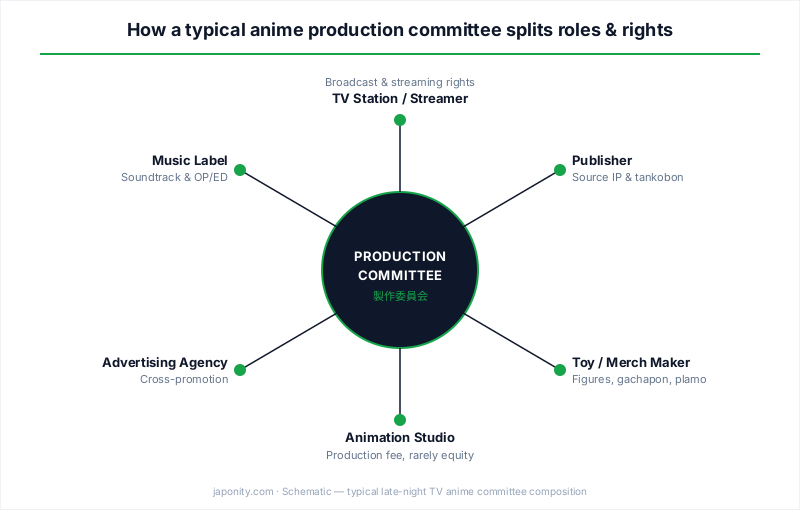
A typical TV anime committee has five to eight members. The composition varies by title, but most include some combination of the following:
| Member | What they bring | What they take |
|---|---|---|
| TV station / streamer | Distribution platform + capital | Broadcast and streaming rights |
| Publisher | Source manga IP (if adapted) + capital | Tankobon (collected manga) and ebook revenue |
| Music / record label | Soundtrack production + capital | Soundtrack, OP/ED single, theme song revenue |
| Toy / merchandise maker | Capital + retail muscle | Figures, gachapon, plastic models, plush, apparel |
| Advertising agency | Sponsor coordination + capital | Sponsorship and brand-collaboration revenue |
| Animation studio | The animation itself | Production fee — and rarely a small equity stake |
For an original (non-adapted) anime, the publisher seat is replaced by a "planning" entity — often a studio, advertising agency, or production house that brought the project to the committee.
The math of a typical late-night TV anime
Public figures are scarce — anime budgets are closely guarded — but industry estimates put a one-cour (12-episode) late-night anime at roughly ¥300–500 million in production cost (approximately $2.0–3.5 million). A "premium" Netflix-commissioned series can run ¥100 million or more per episode.
Each committee member contributes a slice of that budget (often ¥30–100 million depending on the show). In return, each takes the entire revenue from one exploitation channel, then receives a pro-rata share of any combined residual profits — Blu-ray, foreign sub-licensing, mobile games, late-cycle merchandise.
This is the structure that produces the result many foreign observers find surprising: when Demon Slayer: Mugen Train earned over ¥40 billion globally, the lion's share went to Aniplex (Sony Music Entertainment Japan), Shueisha (the publisher), and other committee members. ufotable — the studio that actually drew it — kept a comparatively small slice.
Why the studio captures the smallest share
This is the structural critique that has been made about Japan's anime industry for years. A typical animation studio:
- Funds none of the production cost
- Takes none of the financial risk
- Receives only the production fee (effectively cost reimbursement plus a small margin)
- Sometimes holds 5–10% committee equity, often 0%
The benefit: no downside if the show flops. The cost: no upside if it hits. This is the root of the persistent wage problem in Japan's animation industry. Without equity in the underlying IP, studios have no windfall channel to fund higher animator pay. Industry reports — including the Association of Japanese Animations (AJA) annual report — consistently put rank-and-file animator wages in the bottom quartile of Japan's creative industries.
Three structural problems
- Slow decision-making. Every major use — a foreign streaming deal, a film adaptation, a brand collaboration, a video-game tie-up — typically requires committee assent. Some decisions require unanimous consent. A small committee with aligned interests moves quickly; a large committee with diverging interests can paralyze a project for months.
- Fragmented international rights. A US streamer might license broadcast from one member, while merchandise rights for the US sit with another member's overseas subsidiary, and music rights are held globally by the music label. Foreign buyers often discover mid-deal that they need three separate negotiations to clear what felt like a single product.
- No incentive to invest in talent. Because the studio's economic outcome is the production fee — not the success of the show — there is no business case to share success bonuses with animators, even on megahits.

The shift: IP-owning studios and global commissioning
The committee system isn't dying, but the model is evolving in three observable ways.
1. IP-owning studios
Studios such as ufotable (which holds equity in the Demon Slayer franchise arc), MAPPA (partial self-financing on Chainsaw Man), and WIT Studio are increasingly taking equity in their own productions. They take on more risk, but capture more upside if the show succeeds.
2. Vertical integration by global streamers
Sony's acquisition of Crunchyroll for approximately $1.175 billion in 2021, combined with Aniplex's pre-existing committee positions on many top titles, gives Sony a content-to-distribution pipeline that bypasses parts of the traditional committee structure for international exploitation.
3. Direct commissioning by global platforms
Netflix, Crunchyroll, Disney+, and Bilibili are increasingly funding anime productions directly — sometimes alongside a committee, sometimes replacing it entirely. Studios willing to work on direct-commission models can secure higher budgets and faster decisions, at the cost of long-term IP ownership.
What this means for foreign buyers
If you're a foreign distributor, retailer, brand, or investor approaching Japanese anime in 2026, the practical implications are:
- Identify which committee member holds the right you want. A "studio license" alone usually does not grant the right you need. For streaming, look for the TV/streaming member. For toys, the toy maker. For brand collaborations, the advertising agency or lead producer.
- Expect category-specific deals. You will rarely get one umbrella license. Most arrangements are right-by-right.
- Budget for time. Multi-party approval can take months. Build that into project timelines.
- Foreign capital can now join. Sony/Aniplex, Crunchyroll, Bilibili, Netflix, and Disney+ all hold committee seats on various titles. The door is no longer closed to non-Japanese investors who bring distribution scale.
- Watch for IP-owning studios. When a studio holds the IP itself (rare but growing), you get a single counterparty. This dramatically simplifies negotiation.
Outlook for 2026 and beyond
The production committee system has survived every "this changes everything" moment of the past 25 years — from the DVD boom to streaming to global IP buying. It will likely persist, with three trends accelerating:
- More foreign committee seats as global streamers and capital pools demand IP equity rather than license fees
- More IP-owning studios on the back of recent breakout hits
- More direct-to-streamer commissions as a parallel track alongside committees, not as a replacement
For foreign buyers, brand owners, investors, and researchers, the practical advice is consistent: know the structure, know your counterparty, expect a multi-party deal, and plan for a longer cycle. The committee isn't a bug. It's a feature designed to spread risk across an industry that produces hundreds of titles a year. Once you read it correctly, it works.
Frequently asked questions
What is a production committee in anime?
A production committee (製作委員会, seisaku iinkai) is a multi-company joint venture that funds an anime, holds its rights, and splits its exploitation across members by category — broadcast, music, merchandise, publishing, and so on. It has been the standard funding structure for Japanese TV anime since the late 1990s.
Who actually owns the rights to a Japanese anime?
Each committee member typically owns a specific category of rights: the TV station owns broadcast, the music label owns soundtrack, the toy maker owns merchandise, and so on. There is rarely a single "owner" — rights are unbundled by use.
Why don't animation studios own their work?
Most studios contribute labor (animation) rather than capital, so they do not take a seat on the committee. They earn a production fee but no equity. This protects them from downside but caps their upside — and is the structural root cause of the industry's persistent wage problem.
Has the production committee system changed?
Yes — gradually. Sony's acquisition of Crunchyroll, direct anime commissioning by Netflix and Bilibili, and studios like ufotable and MAPPA holding equity in their own productions are all reshaping the model. But the committee system remains dominant for most TV anime.
Can foreign companies join a production committee?
Yes — increasingly. Sony/Crunchyroll, Bilibili, Netflix, Disney+, and others now hold committee seats on numerous titles. The barriers are practical rather than formal: relationships, language, and willingness to commit early to long production timelines.
Working with Japanese anime IP
For foreign companies looking to license, distribute, or co-invest in Japanese anime IP, the committee system is something to navigate, not avoid. The first step is identifying the right counterparty — the committee member who actually holds the right you want. Japonity's Business Matching service introduces overseas companies to the right contact, whether you're after broadcast rights, merchandise licensing, or co-investment in a future production.
More from Japonity’s Japan Anime Business series
This article is part of a 10-piece editorial cluster on the business of Japanese anime. Read the rest:
- Japan’s Anime Export Boom — Why overseas anime sales topped ¥1.7 trillion and overtook domestic for the first time in 2023.
- The 10 Anime Studios Behind 80% of Output — A ranked, opinionated business map of the studios that dominate foreign-licensed Japanese animation.
- Licensing Anime IP: A 2026 Foreign Buyer’s Guide — Why Western licensing instincts produce wrong answers in Japan, and the eight-stage flow that actually closes deals.
- The New Geography of Anime Streaming — Crunchyroll, Bilibili, Netflix, Disney+ and others split the world by region, rights and business model.
- Why Akihabara Still Matters — Behind the neon, Tokyo’s Akihabara is a working B2B test market for anime IP — a foreign buyer’s walking tour.
- VTuber Economics — Inside the billion-dollar virtual influencer industry built by Cover (Hololive) and ANYCOLOR (Nijisanji).
- The Anime Merchandise Pipeline — From Tokyo factories to Comic-Con booths — how an anime figure actually travels to a foreign retail shelf.
- Japan’s Trillion-Yen Manga Industry — Inside a publishing business larger than anime — and the four Tokyo houses every foreign publisher should know.
- A Day in the Life of an Anime Animator — Inside the working day of a rank-and-file animator, and the structural reasons wages stay low across the industry.
Sourcing beyond anime? Japonity also runs a Japan Sourcing Hub — a research-grade catalogue of 1,185 verified Japanese food products and 200+ overseas EC stores that already stock them, with HS codes, certifications and supplier MOQs ready for B2B procurement.
Interested in Japanese business opportunities?
Whether you're looking for technology partners, engineering talent, or market insights — we can help connect you with the right Japanese organizations.
Get in Touch →