Japan’s anime industry is a $20-billion economy that almost every foreign company misreads on first contact. The reason isn’t culture — it’s structure. Anime is funded, owned and distributed by a particular Japanese corporate format (the production committee) that bundles rights in ways Western licensing playbooks don’t anticipate. This guide is the map: ten in-depth articles, organised by what foreign buyers, investors and partners actually need to know — how the money flows, who holds the rights, where consumption is concentrated, and what the real product opportunities look like.
Why this map exists
Most English-language coverage of anime is fan-led — episode reviews, character explainers, ranking lists. There’s almost nothing written for the foreign executive who is about to sit across the table from Aniplex, Toei, Shueisha, MAPPA or ANYCOLOR and needs to understand what’s actually being negotiated. This series fills that gap. Each article in it is written for a specific question a foreign buyer would walk in with — “who actually owns this?”, “why is the answer never a single counterparty?”, “where do the deals concentrate?”, “is the workforce sustainable?”.
You don’t need to read them in order. Pick the question closest to your role.
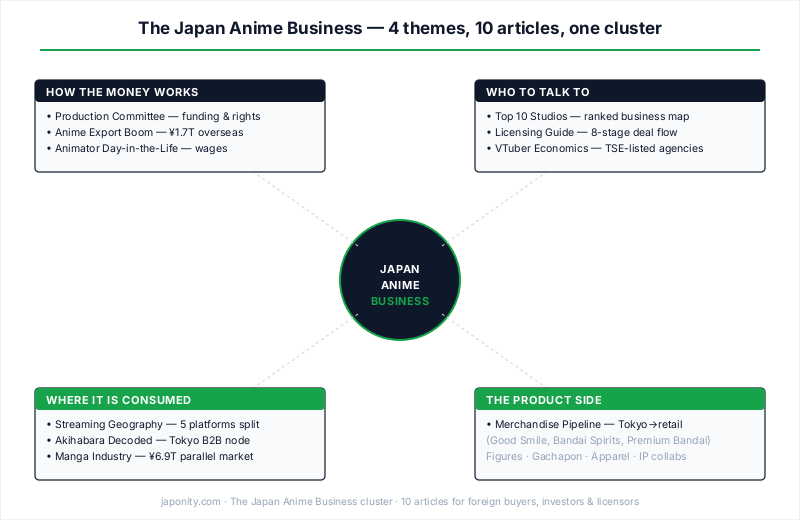
How the money works
If you are an investor, a financier, a streamer, or a publisher considering co-investment, start here. These three pieces decode the financial structure: who funds anime, where the cash actually lands, and the structural reason the people who draw it are paid less than almost any other Japanese creative profession.
- Inside Japan’s Anime Production Committee — The joint-venture structure behind almost every Japanese TV anime. Why ufotable kept a small slice of Demon Slayer‘s ¥40B box office, and how the committee actually distributes broadcast, merchandise, music and overseas rights to its members by category.
- Japan’s Anime Export Boom — Overseas anime sales topped ¥1.7 trillion in 2023 and overtook domestic for the first time. The trade data even METI was slow to react to, and what the geographic split means for foreign licensors.
- A Day in the Life of an Anime Animator — Inside the working day of a rank-and-file in-between animator in Nerima, and the structural reasons wages stay low even as the industry booms globally. The looming labour-capacity ceiling foreign commissioners need to factor in.
Who to talk to
If you’re approaching Japan with a licensing, co-production or brand-collaboration brief, the practical question is: who actually has the authority to say yes? These three articles map the counterparties — the dominant animation studios, the licensing flow itself, and the new wave of TSE-listed talent agencies that don’t fit the traditional studio mould.
- The 10 Studios Behind 80% of Output — A ranked business map of the studios that dominate foreign-licensed Japanese animation. Who holds IP, who runs on committees, where the real deal flow concentrates, and the 2×2 that separates global powerhouses from prestige boutiques.
- Licensing Anime IP: A 2026 Foreign Buyer’s Guide — Why Western licensing instincts produce wrong answers in Japan. The eight stages of a real anime IP deal, the committee-coordination problem, and the practical playbook for getting to signature in months rather than years.
- VTuber Economics — How Japan built a billion-dollar virtual influencer industry. ANYCOLOR (Nijisanji) and Cover (Hololive) are both TSE-listed and profitable — a B2B breakdown of revenue mix, talent splits, agency moats and brand-collaboration windows.
Where the world consumes anime
For a media buyer, retailer, or platform considering distribution rights, the question is geographic. Where does anime actually get watched, sold, and exchanged? These pieces map the consumption side — the streaming-rights map by region, the Tokyo neighbourhood that still anchors the global merchandise loop, and the trillion-yen manga business that quietly sits behind almost every anime IP you’ve heard of.
- The New Geography of Anime Streaming — Crunchyroll, Bilibili, Netflix, Disney+ and a handful of regional platforms now split the world by rights, library and business model. A region-by-region map for media buyers and licensors.
- Why Akihabara Still Matters — Behind the neon, this 1-square-km of Tokyo is a working B2B test market for anime IP. The anchor retailers, the specialty-shop layer beneath them, and why foreign brands still use it as a real-world signal.
- Japan’s Trillion-Yen Manga Industry — Japan’s manga market — print, digital, app — is larger than its anime business. For foreign publishers and investors the entry point is the four Tokyo houses, and the digital revolution has rewritten their P&Ls in ways most outsiders haven’t noticed.
The product side
If you’re a retailer, a brand owner, or an overseas distributor of physical anime merchandise, the supply chain is its own puzzle — separate from broadcast and streaming, with different counterparties at every stage.
- The Anime Merchandise Pipeline — From a Tokyo committee through Good Smile, Bandai Spirits and Premium Bandai to a foreign retail shelf. Why most foreign retailers misread the licensing stack, and the practical entry points for buying figures, gachapon and apparel at scale.
What to take away
Four structural facts run through every article in this series, and each one has business consequences:
- Almost every anime is owned by a committee, not a studio. The studio you’ve heard of (MAPPA, ufotable, WIT, Bones) is usually the labour, not the equity holder. Negotiating with the studio alone rarely clears the right you need.
- Rights are unbundled by category, not by territory. Foreign buyers often discover mid-deal that broadcast, merchandise, music and publishing rights each sit with a different member of the committee, sometimes via different overseas subsidiaries.
- Overseas now matters more than domestic. The 2023 inflection point — overseas > domestic — gives foreign counterparties more leverage than they had even five years ago. Studios and committees actively want global capital and global distribution scale.
- The capacity ceiling is real. Japan’s animation labour pool is finite. As demand from Netflix, Crunchyroll, Bilibili and Disney+ grows, the rate-limiting factor is no longer money — it is animators. Foreign commissioners who don’t factor this in book projects they cannot actually staff.
How to use this guide
If you’re new to Japanese anime as a business, read the production-committee piece first — it’s the structural primer everything else builds on. If you already know how committees work, skip straight to the licensing guide for the practical deal mechanics. If you’re trying to identify counterparties, start with the studio map. If you’re a media buyer or platform, the streaming geography is the right entry point.
Each article is self-contained but cross-linked. Together they amount to roughly 25,000 words of editorial coverage written specifically for foreign business readers — the kind of briefing book most foreign companies have had to commission privately, until now.
Working with Japanese anime — the practical next step
Reading the map is one thing; getting in the room is another. For foreign companies — licensors, retailers, brand owners, co-investors, platforms — the bottleneck is almost never information. It’s the right introduction to the right committee member or studio executive at the right moment.
That’s the gap Japonity’s Business Matching service closes. We work with foreign buyers, investors and brand teams to identify the specific Japanese counterparty (committee seat, studio executive, agency, publisher, or licensing arm) for a defined ask — broadcast rights, merchandise licensing, brand collaboration, co-investment — and introduce them directly. If you’ve read the map and you’re ready to start the conversation, tell us what you’re looking for.
Interested in Japanese business opportunities?
Whether you're looking for technology partners, engineering talent, or market insights — we can help connect you with the right Japanese organizations.
Get in Touch →